 Uni Africa Auto Everything About Cars
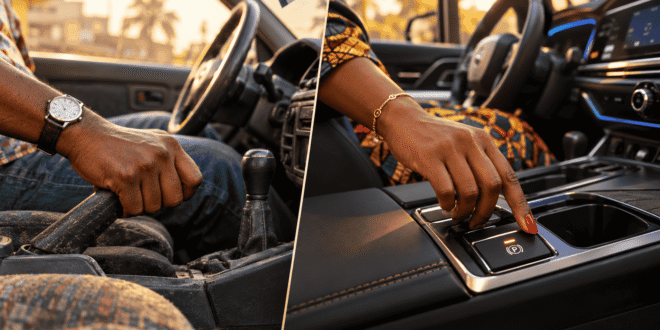
Electronic parking brakes vs traditional handbrakes is a debate that most Nigerian drivers have never had but probably should. If you have recently sat inside a newer Toyota Camry, Honda Accord, or any recent model Hyundai, you may have noticed that the familiar handbrake lever between the front seats has simply disappeared. In its place is a small button on the center console marked with a P and a circle.
Simple. Clean. Futuristic-looking. But is it actually safer?
That question matters a lot in Nigeria, where road conditions, power supply issues, and the general realities of driving in places like Lagos and Abuja create situations that most car manufacturers in Japan or Germany never designed for.
Understanding What Each System Actually Does
Before we compare electronic parking brakes vs traditional handbrakes properly, it helps to understand what each one is doing mechanically.
A traditional handbrake uses a physical cable connected directly to the rear brakes. You pull the lever, the cable pulls the brake, and the car stays put. Simple mechanical action. No electricity required.
An electronic parking brake, called an EPB, replaces that cable with small electric motors mounted on the rear brake calipers. Press the button, and the motors clamp the brakes electrically. Release it by pressing again or simply pressing the accelerator on some cars.
Both systems achieve the same goal. How they get there and what happens when things go wrong is where the comparison gets interesting.
6 Safety Truths About Electronic Parking Brakes vs Traditional Handbrakes
Truth 1: Electronic Parking Brakes Apply More Consistent Clamping Force
One of the clearest advantages of the electronic parking brakes vs the traditional handbrakes comparison is clamping consistency. A physical handbrake depends on how hard you pull it and whether the cable has stretched over time. Many Nigerian drivers have experienced the frustration of a handbrake that feels fine but allows the car to roll slightly on a slope.
An EPB applies a precisely calculated and consistent clamping force every single time. It does not depend on arm strength or cable condition. On a hill in Maitama or a slope in Lekki Phase 1, that consistency matters.
Truth 2: Traditional Handbrakes Win on Emergency Use
Here is where the traditional handbrake holds a real advantage. In a genuine emergency, an experienced driver can use a traditional handbrake to slow or control a car with a brake failure. Rally drivers use this technique deliberately for cornering.
In the electronic parking brakes vs traditional handbrakes safety debate, the EPB loses points here. Most EPB systems are not designed for dynamic emergency use while the car is moving at speed. Pulling a lever that does not exist is not an option.
Truth 3: Electronic Systems Can Fail Without Power
This is a concern that Nigerian drivers should think about seriously. An EPB runs on your car’s electrical system. If your battery is dead, deeply discharged, or your car’s electrical system has a fault, the EPB may not release.
Imagine your car stuck in a parking lot in Wuse market because the battery died and the electronic brake will not disengage. With a traditional handbrake, you release the lever and push. With an EPB, you are calling a tow truck.
According to the AA’s guide to electronic parking brakes, most EPB systems have a manual override procedure, but very few drivers know how to use it.
Truth 4: EPBs Work Better on Steep Nigerian Terrain
Modern electronic parking brakes include auto hold functions that engage the brake automatically when the car is stationary and release it smoothly when you pull away. For drivers navigating the steep inclines of Enugu, the hills of Jos, or the ramps of multi-storey car parks in Victoria Island, this feature is genuinely useful.
Hill starts with a traditional handbrake that requires coordination. With an EPB auto hold, the car simply will not roll back until the engine provides enough power to move forward. For newer drivers, this is a meaningful safety improvement.
Truth 5: Maintenance and Repair Costs Differ Significantly
In the electronic parking brakes vs traditional handbrakes comparison, the maintenance story is important for Nigerian pockets. A traditional handbrake cable that stretches or snaps costs a fraction of the price to replace, and any competent roadside mechanic can handle it.
An EPB actuator motor that fails is a specialist repair. Dealership territory. The parts are imported, the diagnostic equipment is specialized, and the bill reflects all of that.
Get your brake system properly assessed regardless of type at Uni Africa Auto repairs to stay ahead of any brake-related issues.
Truth 6: Newer Nigerian Drivers Actually Adapt Faster to EPBs
This one surprises people. Many drivers who learned to drive on newer EPB-equipped cars report that the system feels more intuitive to them than the traditional handbrake ever did. No pulling technique to master, no forgetting to release it before driving off, and the auto hold feature handles the scenarios that cause anxiety for newer drivers.
In the electronic parking brakes vs traditional handbrakes conversation, this generational aspect is real. The technology is changing what drivers expect from their cars.
Browse well-maintained vehicles with modern safety systems at Uni Africa Auto Car Dealership and find what works best for your driving needs.
So Which One Is Actually Safer?
Both systems are safe when properly maintained and properly understood. The electronic parking brakes vs traditional handbrake debate does not have a single winner because the answer depends on context.
For drivers who value simplicity, low maintenance cost, and emergency use capability, a traditional handbrake is honest and reliable. For drivers who want precision, auto hold convenience, and the benefits of modern integration with the car’s safety systems, an EPB is genuinely the better tool.
What matters most is that whichever system your car has, you understand how it works, maintain it properly, and know what to do when it does not behave as expected.
For a deeper technical comparison, Car and Driver’s brake system guide is an excellent resource worth reading.
Final Thoughts on Electronic Parking Brakes vs Traditional Handbrakes
The shift from traditional handbrakes to electronic systems is happening whether we are ready for it or not. More and more Tokunbo vehicles arriving in Nigeria come with EPBs already fitted. Understanding the difference is no longer just for car enthusiasts.
Know your system. Maintain it well. And make sure your mechanic knows it too.
Which do you prefer — the old school handbrake lever or the modern EPB button? Tell us in the comments below and share this post with a Nigerian driver who is about to buy a newer car.