 Uni Africa Auto Everything About Cars
Why front tires have higher pressure than rear tires? If you’ve ever been at a vulcanizer’s shop and wondered why front tires have higher pressure than rear tires on your car, you’re asking exactly the right question. A lot of drivers either don’t notice the difference or assume it’s a mistake and ask for everything to be “balanced.” That instinct, while understandable, is actually working against you.
The reality is that why front tires have higher pressure than rear tires isn’t some random mechanic’s decision; it’s deliberate vehicle engineering. Understanding it can save you money, protect your tires, improve your fuel economy, and keep you safer on roads that already have more than enough hazards to deal with. Let’s get into it properly.
Why Front Tires Have Higher Pressure Than Rear Tires: The Root Cause
Your Engine Sits at the Front, And It’s Not Light
This is the foundation of the whole thing. On the vast majority of cars driving Nigerian roads today, like your Toyota Camry, Honda Accord, Hyundai Elantra, and Kia Cerato, the engine is mounted at the front of the vehicle. That engine is heavy. Really heavy. And all that weight presses directly down on the front axle and front tires.
Because the front of the car carries significantly more weight than the rear, the front tires need higher pressure to properly support that load. A tire that’s under-pressurized relative to the weight it’s carrying will flex too much, generate excessive heat, wear unevenly, and eventually fail.
This is the most straightforward answer to why front tires have higher pressure than rear tires: the front simply has more weight to carry, so it needs more air pressure to do that job correctly.
Front Tires Are Doing Multiple Jobs at the Same Time
Rear tires have one main job: roll forward. Front tires? They’re handling several things simultaneously. They steer the car left and right. They absorb the impact of potholes, speed bumps, and broken road surfaces hitting them head-on. And on front-wheel-drive vehicles, which covers most modern sedans and hatchbacks, they’re also responsible for transmitting engine power to the road.
That’s steering, shock absorption, and power delivery all happening at once on the same four patches of rubber.
Higher pressure helps the front tires maintain their structural shape under this kind of multi-directional stress. It keeps your steering sharp and responsive, which, if you’ve ever tried to navigate the Apongbon bridge or Berger interchange in Lagos traffic, you know is not something to compromise on.
This multi-role responsibility is a big part of why front tires have higher pressure than rear tires, and it’s not something that changes just because your car looks fine on the outside.
Braking Pushes Weight Forward Every Single Time You Stop
Here’s something most drivers don’t think about. Every time you press the brake pedal, whether gently or in an emergency, your car’s weight shifts forward. This is called weight transfer under braking, and it means your front tires are absorbing significantly more load during every stop than they carry when the car is just sitting still.
Why front tires have higher pressure than rear tires becomes even more obvious when you think about this. Those front tires need to handle not just the static weight of the engine above them, but also the additional dynamic load that slams into them every time you brake.
Under-inflated front tires in this situation lose their shape, reduce road contact, and increase your stopping distance. On a busy Nigerian expressway or anywhere a danfo or truck could stop unexpectedly in front of you, a longer stopping distance is a genuinely dangerous problem.
Front-Wheel Drive vs Rear-Wheel Drive Changes Things Slightly
Not every car is set up the same way, and this is where it helps to know what you’re driving. On front-wheel drive (FWD) vehicles, which include most everyday Nigerian family cars, the front tires are handling steering AND power delivery from the engine. Double duty, all the time. This reinforces exactly why front tires have higher pressure than rear tires on these vehicles.
On rear-wheel drive (RWD) vehicles like your Toyota Hilux, older Mercedes E-Class, classic Peugeot 504 that somehow still dey road, the rear tires take on the power delivery role, so the pressure difference between front and rear may be smaller. In some RWD configurations under heavy load, rear pressure may even be specified higher.
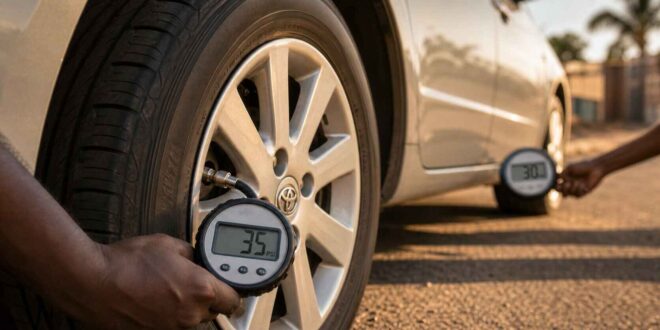
The bottom line? Don’t assume. Check the sticker on the inside of your driver’s door or your owner’s manual. That’s where your manufacturer specifies the exact recommended pressure for both front and rear tires on your specific vehicle. Follow that, not what your neighbor does with his own car.
For a deeper technical breakdown, Tire Rack’s tire pressure guide is one of the most reliable global references on the subject and worth bookmarking.
Getting It Wrong Costs You Real Money
Let’s talk consequences because this is where why front tires have higher pressure than rear tires stops being theoretical and starts affecting your pocket.
Faster tire wear. Wrong pressure on the front tires causes uneven wear patterns. You’ll be buying replacements far sooner than you should be. Good tires aren’t cheap in Nigeria right now.
Higher fuel consumption. Incorrect tire pressure increases rolling resistance, meaning your engine burns more fuel to maintain speed. With petrol prices the way they are, this is money leaving your pocket every single trip.
Sluggish, unpredictable handling. A car with under-inflated front tires feels heavy to steer and slow to respond. That delay when you need to swerve quickly from a pothole, an Okada, or a vehicle that cut in without warning can make a critical difference.
Blowout risk. An overloaded, under-pressurized front tire on a hot Nigerian road surface in the middle of dry season is a blowout risk. And a front tire blowout at speed is far more dangerous than a rear one because it directly affects your ability to steer.
How Often Should You Actually Check?
Once a month is the minimum. Always check before a long interstate journey. Abuja to Kaduna, Lagos to Benin, and Port Harcourt to Owerri. Tires lose pressure naturally over time, and hot weather accelerates that process.
One important thing: always check tire pressure when the tires are cold before you’ve driven more than a couple of kilometers. Hot tires read higher than they actually are when cooled down, which gives you a false sense of security.
And when you’re checking, don’t just look at the front. Check all four, including the spare. A flat spare has ended many a roadside story badly.
What About SUVs, Buses, and Pickup Trucks?
For larger vehicles like the Toyota Land Cruiser Prado, Ford Ranger, commercial buses, and cargo vans, the rear tires may sometimes need equal or higher pressure than the front, especially when carrying heavy loads. Why front tires have higher pressure than rear tires applies most directly to standard passenger cars. Once you start loading the rear of a vehicle heavily, the weight distribution changes and so do the pressure requirements. Always adjust based on your actual load, not just the default empty-vehicle specification.
To Wrap It All Up
Why front tires have higher pressure than rear tires comes down to some very logical reasons: engine weight sitting over the front axle, front tires handling steering and braking stress simultaneously, weight transfer during braking, and the multi-role demands placed on front tires in front-wheel drive vehicles.
Ignoring this isn’t just bad for your tires. It’s bad for your fuel economy, your handling, and ultimately your safety. The fix is simple know your manufacturer’s recommended pressure, check monthly, and adjust properly.
Your tires are the only thing connecting your car to the road. Everything else depends on them being right.
Experiencing tire problems or not confident your vehicle’s pressure is set correctly? For all your tire trouble, visit https://repairs.uniafricaauto.com/ — and let the professionals sort it out properly.
Have you ever had a front tire blowout or noticed your car handling differently after a pressure check? Do you now understand why front tires have higher pressure than rear tires on your vehicle? Share your experience in the comments below; we’d love to hear it. And if this was helpful, pass it on to another Nigerian driver who needs to know this. It might save them a bad day on the road.